FMU models
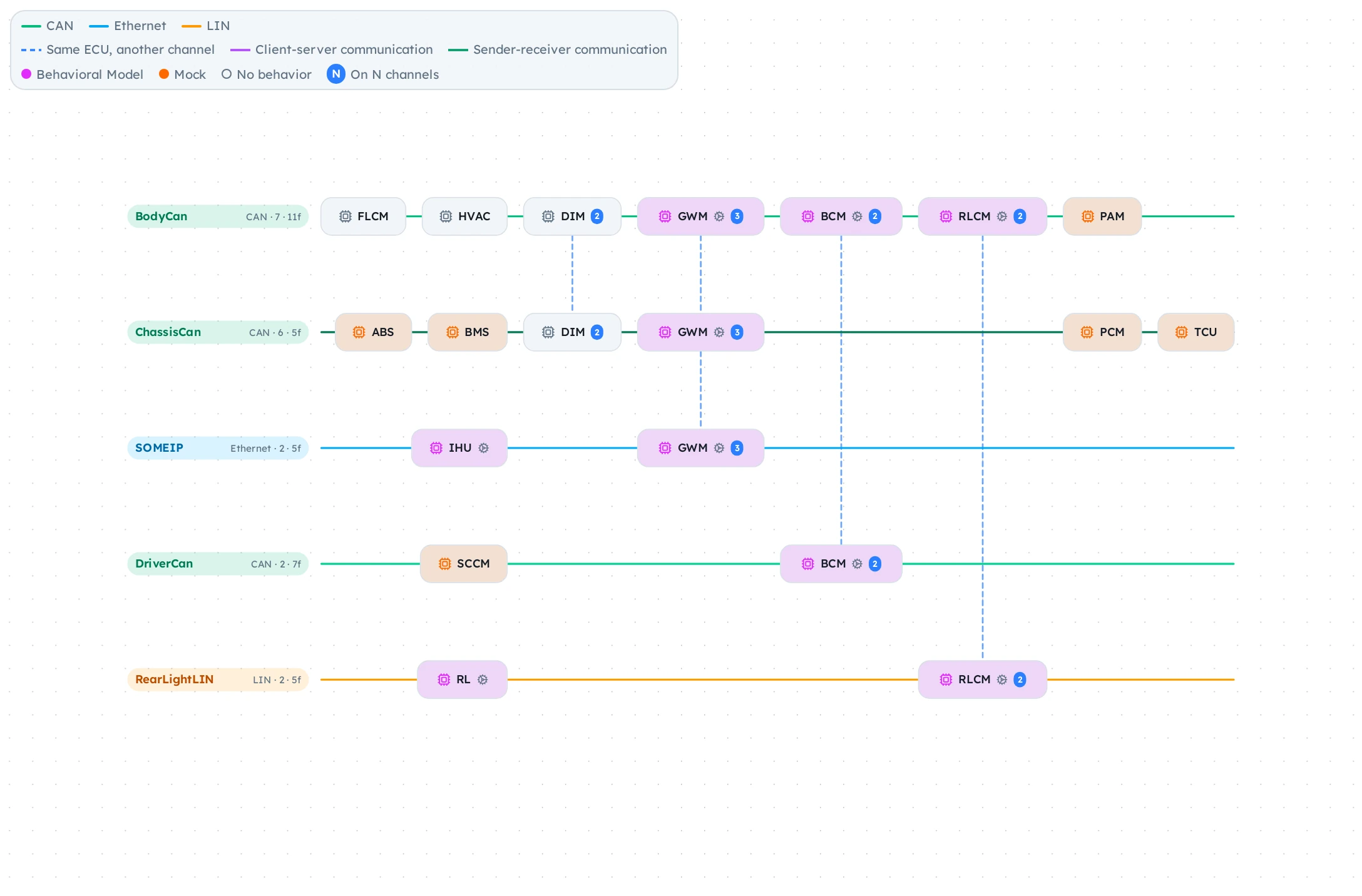
Run it
git clone https://github.com/remotivelabs/remotivelabs-remotive-car.git
cd remotivelabs-remotive-car

remotive topology build \
  -f instances/fmu/main.instance.yaml \
  -f settings/can_over_udp.settings.instance.yaml \
  build

docker compose -f build/remotive_car_fmu/docker-compose.yml up --build
Using Functional Mock-up Units (FMUs) allows you to integrate standardized simulation models as ECU behavior. This is useful when the model of an ECU already exists as an FMU, for instance exported from a modelling tool, and you want to run it against the real communication of the rest of the platform.
RemotiveTopology maps network signals onto the input variables of the FMU, steps the FMU, and publishes its output variables back onto the bus. The model itself needs no knowledge of the platform.
- Part of the RemotiveCar example
- Instance: RemotiveCar FMU instance
- FMU model: bcm/fmu
- Instance file: BCM/fmu.instance.yaml
The BCM of the RemotiveCar example has two interchangeable implementations, a
python behavioral model and an FMU. Both
are driven by the same signals and verified by the same tests, so the two instances are a direct comparison of the two
approaches.
Notice:
- FMU support is an optional dependency of the library, install it as
remotivelabs-topology[fmu]. - The FMU declares its own step size, and RemotiveTopology steps it at that rate. The
BCMFMU uses 50 ms. - Which signal feeds which FMU variable is declared as data, in the
INPUT_MAPPINGof the model. Only the outputs need a few lines of code, to publish them on the restbus.